PharmaGossipAtLast

  • Subscribe to our RSS feed.
  • Twitter
  • StumbleUpon
  • Reddit
  • Facebook
  • Digg

Wednesday, July 31, 2013

Still a fantastic read

Posted on 9:28 PM by Unknown
http://hcrenewal.blogspot.co.uk/
Read More
Posted in | No comments

GlaxoChinaGate contd. - Nothing uniquely Chinese about Glaxo bribery case

Posted on 9:14 PM by Unknown


The pharmaceutical industry routinely bribes doctors in the West to get its drugs prescribed, although the practice is given a thin façade

By Tom Holland

The media have been in a frenzy for the last few weeks over the detention of four GlaxoSmithKline employees in China.

Allegedly the four had channelled billions of yuan through a travel agency in order to bribe doctors to prescribe the British pharmaceutical company's drugs.

Reports have variously described the case as an attack on foreign companies by protectionist local authorities, a politically driven plot to marginalise the princeling children of late Communist Party general secretary Hu Yaobang, or a populist move by China's new leadership to bring down drug prices.
It may well be all three. China's leaders have always been adept at killing multiple birds with a single stone.

But one thing the Glaxo case is certainly not, despite what the reports make out, is uniquely Chinese.

When Glaxo chief executive Andrew Witty insisted last week he knew nothing about any bribe-paying by the company's staff in China, telling London's The Daily Telegraph "this looks like a number of individuals that have worked outside our systems", he was being disingenuous.

Sure, no doubt Witty was unaware of the details. But allegations that his employees were paying bribes to secure sales certainly came as no surprise. In the drug industry, it's almost standard practice.

Over the last 15 years or so, big pharmaceutical companies have switched from a model based on developing new drugs to one based on the aggressive marketing of existing products.

Marc-André Gagnon, a professor of public policy at Carleton University in Ottawa, likens the way the business works to three customers at a restaurant table. The first orders lunch. The second eats it. And the third pays the bill.

At this restaurant, however, the waiter is paid on commission. Not surprisingly, he presses the first customer to order the most expensive dishes on the menu. He may even promise him a couple of martinis on the house if he orders an especially lavish meal, whether or not it suits the second customer's digestion, or the third's pocket.

The first customer here is the doctor, responsible for prescribing drugs. The second is the patient. And footing the bill, the third is either the patient's insurance company or the state health-care system, depending on the country.

In reality, drug companies splash out on a lot more than martinis. The stories of 3 billion yuan (HK$3.78 billion) passed to a travel agent suggests Glaxo's staff were funding expensive jaunts to reward doctors for prescribing their drugs.

This is a time-honoured tactic in the West. Ostensibly, the doctor is attending a medical conference, which just happens to be in an exotic location. In reality he is enjoying a free holiday in a luxury beach resort.

Drug companies also pay doctors handsomely for consultancy services, writing papers, and participating in clinical trials. All are bribes for prescribing, or rather over-prescribing, drugs.

In China, where medical salaries can be just a few hundred yuan a month, doctors rely heavily on this extra income.

But the practice is just as common in other markets. According to Gagnon, in the US, the pharmaceutical industry spends some US$40 billion a year on promoting drugs to doctors. That's US$61,000 for each physician.

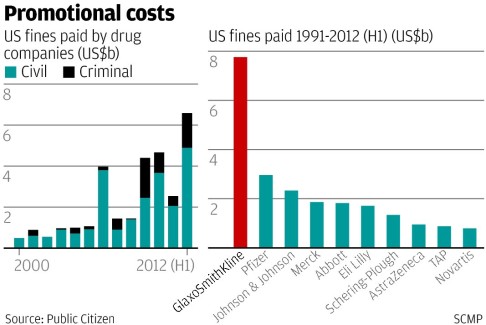
And drug companies often overstep the mark into illegality. Since 1991, they have paid US$29 billion in fines in the US alone.

By far the biggest offender is Glaxo. Just last year it paid US$3 billion to settle a US federal suit for paying bribes and unlawfully promoting three drugs. Overall, since 1991, Glaxo has paid a stunning US$7.6 billion in US penalties (see charts).

So, no, there is nothing especially Chinese in the latest drug-industry corruption case, except perhaps for the amount of media attention it is getting.

http://m.scmp.com/business/companies/article/1293460/nothing-uniquely-chinese-about-glaxo-bribery-case

Read More
Posted in | No comments

Hope for the future

Posted on 8:43 PM by Unknown
http://www.pharmfree.org/

http://www.amsa.org/AMSA/Homepage/Events/AMSAConferences.aspx
Read More
Posted in | No comments

Slumdog clinical trials contd. - BMJ editorial: India's research participant protection policy

Posted on 8:37 PM by Unknown

Experts say action needed urgently to ensure new policy does not backfire

In an editorial published online today in BMJ, Johns Hopkins bioethicist Jeremy Sugarman and other experts warn that action is urgently needed to deal with possible unintended consequences of India's new policy protecting research participants.

Passed earlier this year, the Drugs and Cosmetics Act (First Amendment) Rules, was meant to mitigate ethical concerns with potential serious consequences for public health, as well as India's viability as a continued global leader in clinical research. However, Sugarman and his co-authors highlight specific concerns that could lead to the policy having the opposite effect, including a table of the policy's "Conditions attributable to clinical trial injury or death." One of these is "use of placebo in a placebo controlled trial," to which the authors respond that "placebos are not necessarily harmful. Indeed the use of a placebo is often the only way of truly assessing whether the agent under study is associated with undue risk or significant benefit."

Among the authors other concerns is the policy's call to compensate research participants for injury for "failure of investigational product to provide intended therapeutic benefit," arguing that the purpose of the trial is to determine just that.

The authors give short and anticipated long-term ramifications of the policy, noting that at least 35 collaborative research projects funded by the US National Institutes of Health have been suspended since March 2013, most investigating large scale public health problems. They also note that India is the main supplier of antiretrovirals to donor supported HIV treatment programs in developing countries, and the dramatic fall in clinical trial applications that is already taking place could have a ripple effect on the availability of registered drugs.

"It is essential that the unintended consequences of the new policy are dealt with effectively but rapidly," the authors write. "The relevance, impact, and quality of global health research have been greatly strengthened by engagement of Indian scientists and participation of Indian research volunteers. Advances in health research need India's leadership and participation."

Read the editorial in BMJ: http://www.bmj.com/content/347/bmj.f4841.pdf%2Bhtml

Jeremy Sugarman: http://www.bioethicsinstitute.org/people/jeremy-sugarman-4

Read More
Posted in | No comments

Let the sunshine in

Posted on 2:53 PM by Unknown

Pharmaceutical Companies Will Soon be Required to Publicly Report Payments to Doctors; The Canadian Pharmacy Says It's Time to Stop Unfairly Influencing Prescribers

Winnipeg, Manitoba (PRWEB) July 31, 2013

The Physician Payments Sunshine Act, passed as part of the United States' Affordable Healthcare Act, requires that on August 1, 2013, manufacturers of pharmaceutical and medical devices begin to collect and document all payments made to physicians and teaching hospitals over the amount of $10. This includes any and all forms of payment such as gifts, honorariums and awards, stock options, royalties and research funding.

These "perks" have long been a part of the dance between pharmaceutical companies and physicians. While a part of the physician's job is to remain neutral and prescribe the medication or treatment best suited for an individual patient's condition, pharmaceutical companies have a product to sell and want their product to be the first that comes to mind when the doctor pulls out the prescription pad and pen - which may itself have a logo emblazoned upon it.

As legislators were crafting the Affordable Healthcare Act, it became clear that in order to reduce drug costs and increase transparency, this situation had to be addressed. Despite a physician's best intentions, each one is only human and may be influenced, even unintentionally. By collecting payment data and creating a database accessible to the public, patients can see for themselves how much money their physician or hospital has received from pharmaceutical companies. Information is power, and patients have the opportunity to make an informed decision as to whether they feel their prescriber may have been influenced.

Doctors and administrators at teaching hospitals have raised concerns about how this information will be categorized and represented and whether the media and the public will fully grasp the nuances and differences between different types of payments. Another significant area of concern is the potential for mistakes. While a dispute-resolution system is being established as part of the Act, it is still unclear how efficiently this system will work.

Harry Greenberg, the senior associate dean for research at Stanford University's School of Medicine, has raised concerns about whether the exact purpose of the money gifted will be addressed in the database. As he points out, there is a vast difference between money that goes directly into a physician's pocket and money that is used to fund potentially life-saving research.

David Zimmer, President of The Canadian Pharmacy, an online pharmacy in Canada dedicated to providing high-quality medication to both Canadian and international patients in a safe and cost-effective manner, is excited by the potential of increased transparency in doctors' prescribing practices. "This law aims to help medical consumers make more informed decisions and alert them to any potential conflicts of interest that their health care providers may hold," he says. "The Canadian Pharmacy applauds this effort to increase transparency and, hopefully, decrease health care costs in the United States. Practices that are detrimental to the availability and affordability of medication are also detrimental to public health, and it's time for these practices to be addressed and prevented."

Online Canadian pharmacy TheCanadianPharmacy.com has been serving consumers for the past 10 years by providing significant cost savings on prescription medication. The Canadian Pharmacy is certified by both the Canadian International Pharmacy Association and the Manitoba International Pharmacist's Association.

About The Canadian Pharmacy:

The Canadian Pharmacy is an online Canadian pharmacy based in Winnipeg, Manitoba. Dedicated to helping consumers save money on safe, high-quality prescription drugs, the pharmacy is certified by the Better Business Bureau, CIPA and MIPA and also has a 5-Check rating from PharmacyChecker.com. Every staff member of The Canadian Pharmacy is also certified by CIPA, and licensed pharmacists and physicians are available to assist patients with all of their questions and concerns.

http://www.prweb.com/releases/CanadianPharmacy/2013/prweb10981543.htm

Read More
Posted in | No comments

Hongbao - the red envelope

Posted on 2:58 AM by Unknown
http://hosted.ap.org/dynamic/stories/A/AS_CHINA_BRIBING_DOCTORS?SECTION=HOME&SITE=AP&TEMPLATE=DEFAULT
Read More
Posted in bribery, china, glaxo, gsk, hongbao, scandal | No comments

Tuesday, July 30, 2013

Sharing data from clinical trials: where we are and what lies ahead -BMJ

Posted on 2:42 PM by Unknown


BMJ 2013; 347 doi: http://dx.doi.org/10.1136/bmj.f4794 (Published 30 July 2013)
Cite this as: BMJ 2013;347:f4794
  • Elizabeth Loder, associate editor

Author Affiliations

  1. eloder@bmj.com

The drive to make clinical trial data more accessible has garnered widespread international support, but rearguard actions by the drug industry could delay substantial change. Elizabeth Loder looks at international developments in the sharing of clinical trial data

Almost a decade ago an Italian scientist, Alessandro Liberati, wrote an impassioned Personal View in the BMJ. He had developed myeloma and needed to decide whether to have a second bone marrow transplant. Among the evidence pertinent to his decision were “four randomised controlled trials, whose results haven’t yet been fully published . . .” “Why,” he asked, “was I forced to make my decision knowing that information was somewhere but not available?” He concluded that “Research results should be easily accessible to people who need to make decisions about their own health.”1 His story put a human face on the harm that can occur when clinical research data are not available.

In 2003 the US National Institutes of Health (NIH) published a final statement on sharing of data from research activities it had funded. The statement reaffirmed support for the concept of data sharing, which NIH said was “essential for expedited translation of research results into knowledge, products, and procedures to improve human health.” Henceforth, NIH announced, investigators seeking NIH grants over $500 000 (£325 000; €377 000) or more would be “expected to include a plan for data sharing or state why data sharing is not possible.”2

It is difficult to identify exactly when the crusade began for better access to clinical trial data, but this action by NIH was certainly among the opening salvos in the struggle. Over the past decade, the movement for clinical trial data transparency has become global in scope, with European regulators, health research funders, and international coalitions of scientists taking a prominent role. Proponents of research data sharing say that increased access to clinical trial data will spur more efficient drug development and scientific innovation, increase trust in the clinical research enterprise by providing opportunities for close scrutiny of research results, and ultimately improve public health.3 They want wider access to the full spectrum of information gathered in clinical trials—not just aggregate data but also anonymised patient-level data and supporting information that would enable independent replication of trial results and facilitate individual patient data meta-analyses.4 These arguments have been met with sympathy by a diverse group of international organisations, and the movement towards the transparency of clinical trial data has gathered pace.

All aboard the bandwagon

Journals

Medical journals were among the first to endorse wider sharing of trial data, and to take steps to make it happen. In 2007 Annals of Internal Medicine began to require data sharing statements for research studies published in the journal, and in 2009 theBMJ introduced a similar policy.5 6 In 2013 the BMJ went further, requiring as a condition of publication that authors of drug and device studies agree to make relevant anonymised patient level data available on reasonable request.7 In mid-June of this year the BMJ and PLOS Medicine endorsed the RIAT (Restoring Invisible and Abandoned Trials) initiative, which provides a mechanism for the publication of unpublished studies and correction of those that were inaccurately reported—ideally by the original trial researchers or sponsors, but failing that by volunteer “restorative authors.”8 The effort is only possible because the authors of the RIAT proposal have access to detailed clinical trial data for a large number of drugs, most of it obtained in the course of legal proceedings.

Funders of Health Research

In 2011 an international group of private and governmental funders of medical research signed on to a joint statement that strongly endorsed “making research data sets available to investigators beyond the original research team in a timely and responsible manner, subject to appropriate safeguards.”9 Signatories included Inserm, the Wellcome Trust, and the UK Medical Research Council, along with the NIH, World Bank and others. The statement outlined both immediate and long-term goals, including a desire to change the culture of research so that data sharing will be “recognised as a professional achievement” and maintaining and sharing “well managed datasets” recognised as “an important professional indicator of success in research.”

Governmental bodies and regulators

In late 2010 the European Medicines Agency (EMA) began to release, on request, clinical trial documents and other reports that had been submitted by drug companies to support requests for drug authorisations. By April 2013, 1.9 million pages of information had been released.10 EMA has been explicit about its view that such data “should not be considered commercial confidential information.”11 In June of this year, a draft policy on publication and access to clinical trial data was released for public comment; the final policy will be published in the fall of 2013.12

Another project of note is the plan to revise current European Union (EU) clinical trial directives. The proposed EU clinical trial regulations, unlike the directives they would replace, would be binding and would not be subject to interpretation by EU member states. Among other things, they would require sharing of trial information in the form of clinical study reports (CSRs). The EU also aims to launch its own trial registry, similar to the US based ClinicalTrials.gov.13

The UK National Research Ethics Service, which is directed by the new UK Health Research Authority, will not only make trial registration a condition of ethical approval for research, but will also make sure that consent is sought from research participants in ways that will “not be a later barrier to data sharing . . .”14

Broad coalitions

January 2013 saw the launch of the AllTrials campaign, which unites a broad coalition of patient groups, private and public organisations, medical journals, researchers, medical professionals, and individuals. The group’s slogan is “All trials registered, all results reported” and it is petitioning “governments, regulators and research bodies to implement measures to achieve this.” AllTrials proposes that clinical study reports should be released or, in the case of academic or other non-industry funded trials, information equivalent to CSRs.15

Pledges of reform: companies say yes but do some mean no?

Meanwhile, in response to mounting criticism and the pressure of public opinion, some pharmaceutical companies have responded with initiatives to make more clinical trial information available. The most notable commitment has come from GlaxoSmithKline (GSK). The company has launched an online portal that provides a list of GSK studies for drugs that have received regulatory approval or, in the case of drugs for which approval will not be sought, those studies submitted for publication. The portal also lists studies that have not been published. More detailed data from these studies will be made available to investigators who submit analysis plans and commit to publication of their findings, subject to approval of an independent third party panel. GSK has also endorsed the AllTrials initiative.16

Roche, acknowledging the ongoing controversy about the accuracy and completeness of published trial information for the influenza drug oseltamavir, announced plans in February 2013 to make data for approved drugs available to researchers whose analysis plans are approved by an independent review body. Roche also plans to provide access to anonymised patient-level data from some studies.17

Device manufacturer Medtronic has pioneered a new model of clinical trial data release and scrutiny in partnership with a team of researchers from Yale Medical School. Medtronic’s commitment was motivated by falling sales of its bioengineered bone growth product rhBMP-2. This drop in sales came amid questions about the integrity of published clinical trial information for the drug, concerns that had been raised by the Spine Journal.18 Yale researchers selected two independent groups to analyse the data and Medtronic agreed that the findings, whatever they were, would be published. The two reviews, released in June 2013, concluded that the benefits of the product were small and that side effects and harms had been under-emphasised in original publications.19 20

Although some companies seem to be genuinely struggling to adjust to a new world of shared data, others appear to be trying to hinder progress. Backed by the drug industry lobbying group Pharmaceutical Research and Manufacturers (PhRMA) in the US, the drug companies AbbVie and InterMune sued the EMA to prevent it from releasing information about their drugs in response to two requests for access. In May 2013 the General Court of the EU issued an interim ruling ordering the EMA not to provide any more documents, pending a final ruling from the court.21

PhRMA and its European counterpart EFPIA (European Federation of Pharmaceutical Industries and Associations) have emerged as key orchestrators of continued industry resistance to data transparency efforts. A memorandum from the two lobbying groups leaked to the Guardian had been sent to leaders of major pharmaceutical companies around the world. It outlined a strategy of “mobilising patient groups to express concern about the risk to public health by non-scientific re-use of data.”22

Several patient groups were quick to repudiate this strategy and reaffirm their commitment to data accessibility. They also took offence at the Guardian’s statement that an “army” of patient groups had been raised. The European Patients Forum was blunt, saying “we denounce the accusation that ‘an army of patients groups are being mobilised by pharma to lobby against plans to force companies to publish secret documents on drugs trials’ . . . We are not aware of any bona fide patient group that would advocate another stance . . . ”23 The European Aids Treatment Group acknowledged receiving substantial funding from drug companies but commented that “We believe that patients do a great service, willingly participating in clinical trials for the benefit of medical science and the greater good . . . It is a travesty of justice that this data is then considered to be ‘private.’ It should be in the public arena for all to see—easy to access and free for all.”24

In late July 2013 PhRMA and EFPIA released a set of principles for sharing data from clinical trials, which member organisations will adopt effective from January 2014. The principles outline mechanisms to make some clinical trial data available to approved researchers. They also affirm a commitment to the publication of all clinical trial results and to sharing summary trial results with the public. Critics, however, were quick to say that the principles do not go far enough, and derided them as an attempt to pre-empt alternative, more comprehensive plans for data sharing. 25

Adjusting to a new normal

While rearguard actions by the pharmaceutical industry may weaken or delay progress towards more complete access to clinical trial data, they are unlikely to be successful in the long run. The public is increasingly intolerant of the idea that commercial or other interests should be permitted to hoard information and have sole control over access to it. This cultural shift in attitudes about information sharing is based on a belief that clinical trial data are a valuable public good.26 There is strong, sustained support for data sharing from many sectors of society, well illustrated by the breadth and diversity of signatories to the AllTrials petition. All of this points to a future where sharing of research data is viewed as an essential characteristic of good science. The recent testimony of Roche director William Burns before the UK House of Commons Science and Technology Committee suggests that there is growing industry recognition of this new reality: “What we’ve seen is an increasing requirement over recent years for more stakeholders to have more access to the data, and if society wants that to happen, then we have to respond.”27

Notes

Cite this as: BMJ 2013;347:f4794

Footnotes

  • Competing interests: I have read and understood the BMJ Group policy on declaration of interests and have no relevant interests to declare.

  • Provenance and peer review: Commissioned; not externally peer reviewed.

References

  1. ↵
    Liberati A. An unfinished trip through uncertainties.BMJ2004;328:531.
    FREE Full Text
  2. ↵
    US National Institutes of Health. Final NIH statement on sharing research data. 2003. http://grants.nih.gov/grants/guide/notice-files/not-od-03-032.html
  3. ↵
    National Academies Collection: Sharing clinical research data: workshop summary. Institute of Medicine, Washington, DC: National Academies Press (US); 2013, p 9.
  4. ↵
    Gotzsche P. Why we need easy access to all data from all clinical trials and how to accomplish it. Trials2011;12:249.
    CrossRefMedline
  5. ↵
    Laine C, Goodman SN, Griswold ME, Sox HC. Reproducible research: moving toward research the public can really trust. Ann Int Med2007;146:450-53.
    Medline
  6. ↵
    Groves T. Managing UK research data for future use.BMJ2009;338:b1252.
    FREE Full Text
  7. ↵
    Godlee F, Groves T. The new BMJ policy on sharing data from drug and device trials. BMJ2012;345:e7888,doi:10.1136/bmj.e7888.
    FREE Full Text
  8. ↵
    Doshi P, Dickersin K, Healy D, Vedula SS, Jefferson T. Restoring invisible and abandoned trials: a call for people to publish the findings.BMJ2013;346:f2865.
    FREE Full Text
  9. ↵
    Wellcome Trust. Sharing research data to improve public health. www.wellcome.ac.uk/About-us/Policy/Spotlight-issues/Data-sharing/Public-health-and-epidemiology/WTDV030690.htm.
  10. ↵
    European Medicines Agency. Publication and access to clinical trial data. www.ema.europa.eu/ema/index.jsp?curl=pages/special_topics/general/general_content_000556.jsp.
  11. ↵
    Eichler H-G, Abadie E, Breckenridge A, Leufkens H, Rasi G. Open Clinical Trial Data for All? A View from Regulators. PLoS Med2012;9:e1001202, doi:10.1371/journal.pmed.1001202.
    CrossRefMedline
  12. ↵
    European Medicines Agency. Draft policy 70: Publication and access to clinical trial data. www.ema.europa.eu/ema/doc_index.jsp?curl=pages/includes/document/document_detail.jsp?webContentId=WC500144730&murl=menus/document_library/document_library.jsp&mid=0b01ac058009a3dc.
  13. ↵
    European Commission. Proposal for a regulation of the European Parliament and of the council on clinical trials on medicine products for human use, and repealing Directive 2001/20/EC. http://ec.europa.eu/health/files/clinicaltrials/2012_07/proposal/2012_07_proposal_en.pdf
  14. ↵
    UK Health Research Authority. UK Health Research Authority/National Research Ethics Service Transparency policy. www.hra.nhs.uk/EasysiteWeb/getresource.axd?AssetID=152136&type=full&servicetype=Attachment
  15. ↵
    Alltrials.net. All trials registered, all results reported. www.alltrials.net/
  16. ↵
    GlaxoSmithKline. Data transparency. www.gsk.com/explore-gsk/how-we-do-r-and-d/data-transparency.html
  17. ↵
    Roche. Roche launches new process for accessing clinical trial data. www.roche.com/media/media_releases/med-cor-2013-02-26.htm
  18. ↵
    Carragee EJ, Ghanaem AJ, Weiner BK, Rothman DJ, Bono CM. A challenge to integrity of spine publications: years of living dangerously with the promotion of bone growth factors. Spine J2011;11:463-8.
    CrossRefMedline
  19. ↵
    Simmonds MC, Brown JV, Heirs MK, Higgins JP, Mannion RJ, Rodgers MA, et al. Safety and effectiveness of recombinant human bone morphogenetic protein-2 for spinal fusion. A meta-analysis of individual-participant data. Ann Intern Med2013;158:877-89.
    CrossRefMedline
  20. ↵
    Fu R, Selph S, McDonagh M, Peterson K, Tiwari A, Chou R, et al. Effectiveness and harms of recombinant human bone morphogenetic protein-2 in spine fusion. A systematic review and meta-analysis. Ann Intern Med2013;158:890-902.
    CrossRefMedline
  21. ↵
    Carroll J. EMA vows to battle AbbVie in courts for full data transparency. FierceBiotech. 2013. www.fiercebiotech.com/story/ema-vows-battle-abbvie-courts-full-data-transparency/2013-05-01.
  22. ↵
    Sample I. Big Pharma mobilising patients in battle over drugs trials data. Guardian2013. www.guardian.co.uk/business/2013/jul/21/big-pharma-secret-drugs-trials
  23. ↵
    AllTrials.net Patient groups respond to EFPIA and PhRMA leaked memo. http://www.alltrials.net/2013/responses-to-leaked-memo/
  24. ↵
    European AIDS Treatment Group. Big pharma mobilising patients in battle over drugs trials data. 2013. www.eatg.org/news/168638/EATG_statement%3A_Big_pharma_mobilising_patients_in_battle_over_drugs_trials_data
  25. ↵
    Pharmalive. Pharma adopts data sharing plan, but critics deride “caveats.” 2013 www.pharmalive.com/pharma-adopts-data-sharing-plan-but-critics-deride-caveats.
  26. ↵
    Kimmelman J, London A. Clinical trials and the public good: testing innovative therapies is more than a private affair. Science Progress. 2010. http://scienceprogress.org/2010/06/clinical-trials-and-the-common-good/.
  27. ↵
    O’Dowd A. GSK and Roche tell MPs that more clinical trial data should be published. BMJ2013;346:f2639, doi:10.1136/bmj.f2639.
    FREE Full Text
Read More
Posted in | No comments
Newer Posts Older Posts Home
Subscribe to: Posts (Atom)

Popular Posts

  • Beautiful Barcelona! - Gedeon Richter ruled in breach of ABPI code
    LYNNE TAYLOR Gedeon Richter (UK) has breached the Association of the British Pharmaceutical Industry (ABPI) Code of Practice, and has brough...
  • GlaxoChinaGate contd. - Bwaaa!
    China Drug Probe 'Unfair,' Euro Group Says Thu, 09/05/2013 - 8:30am Foreign companies believe they are unfairly being singled out fo...
  • Another day, another J&J recall ... Mold found in schizophrenia drug forces Johnson & Johnson recall
    By  Bloomberg News  on September 11, 2013 at 5:25 PM, updated  September 11, 2013 at 5:27 PM Johnson & Johnson has recalled 5,000 vials ...
  • AllTrials Update
    Dear Friends Support for AllTrials around the world is growing and we need to keep it that way as we reach some crucial debates. The Europea...
  • Hurrah!
    Press Release 11 September 2013 FOR IMMEDIATE RELEASE The HRA is now implementing its plans for ensuri...
  • Advertisement
    The book addresses, in great, evidence-based detail, a general system failure caused by widespread crime, corruption, bribery and impotent d...
  • Of pigs and penicillin
    Extended Withdrawal Needed to Avoid Penicillin G Residues News US - A minimum 51-day withdrawal is necessary if penicillin G is used in pigs...
  • The Lancet has formally retracted the Jikei Heart Study paper, originally published in 2007
    . The retraction had been widely anticipated for more than a month, after a series of news reports in Japan made it clear that the long-simm...
  • Wrigley holds off on caffeinated gum as FDA reviews caffeine
    By Melissa Healy 7:54 p.m. EDT, May 9, 2013 Less than a week after the Food and Drug Administration announced that it would investigate the ...
  • Petition by Professor David Healy - please sign if you agree
    Let us see Drug Data! Drug hazards are not “trade secrets”! Drug companies maximize the sales of new drugs by hyping their benefits while do...

Categories

  • Abbott (1)
  • alltrials (1)
  • alosetron (1)
  • AstraZeneca (1)
  • Baxter (1)
  • big pharma (2)
  • bribery (7)
  • Champix (1)
  • chantix (1)
  • china (7)
  • Clinical Trails (1)
  • Clinical Trial (1)
  • corruption (5)
  • Dan Markingson (1)
  • Dan Markingson Death (1)
  • diabetes (2)
  • Diovan (1)
  • EFPIA (1)
  • glaxo (11)
  • Glaxo China bribery corruption (1)
  • gsk (7)
  • hongbao (1)
  • insurance (1)
  • Januvia (1)
  • johnson and johnson (1)
  • Lotronex (1)
  • Mefloquine (1)
  • Mental Health (1)
  • Merck (2)
  • Novartis (1)
  • pancreas (1)
  • pfizer (1)
  • pharma (1)
  • pharmaceuticals (1)
  • PhRMA (1)
  • quetiapine (1)
  • Sanofi (2)
  • scandal (1)
  • seroquel (1)
  • side effects (1)
  • suvorexant (1)
  • ucb (1)
  • Valsartan (1)
  • Zaltrap (1)

Blog Archive

  • ▼  2013 (300)
    • ►  September (40)
    • ►  August (70)
    • ▼  July (104)
      • Still a fantastic read
      • GlaxoChinaGate contd. - Nothing uniquely Chinese a...
      • Hope for the future
      • Slumdog clinical trials contd. - BMJ editorial: In...
      • Let the sunshine in
      • Hongbao - the red envelope
      • Sharing data from clinical trials: where we are an...
      • Pfizer Pleads Guilty, Pays $491 Million Over Rapam...
      • Caveat lector!
      • Now this is worrying
      • FDA toughens malaria drug labeling because sometim...
      • An addiction that is hard to break
      • GlaxoChinaGate contd. The case of Zhao Hongyan, th...
      • Perrigo buys Irish drug maker Elan in $8.6bn deal
      • 1boringoldman makes the case for data transparency
      • GSK investigation reveals something rotten - China...
      • The Glaxo-China Bribery Scandal: A New Policeman W...
      • UK pharma shows signs of dangerous addiction
      • Paul Krugman: China’s economy has hit its Great Wall
      • Class-action suit over Pfizer Canada's anti-smokin...
      • GlaxoChinaGate contd. - Reilly to return to China!
      • China state media says 18 more detained in GSK probe
      • Bergstroem's mobilising memo
      • GlaxoChinaGate contd.- The World of Suzie Wang
      • GlaxoChinaGate contd. - is this the payoff?
      • Big Pharma’s data sharing principles “weak and fil...
      • GlaxoChinaGate contd. - the Chinese police reveal ...
      • Banks and Big Pharmas hire private eyes who break ...
      • Pharma industry downplays lobbyism with patient gr...
      • Meanwhile, in other GSK news...
      • GlaxoChinaGate contd. Witty may not be forthcoming...
      • The World According to Monsanto
      • Patient groups commit to transparency after leaked...
      • GSK's China crisis: questions for Witty that need ...
      • More Astra staff held in China as GSK crisis deepens
      • Antimalarial Drug Linked to Sgt. Robert Bales Mass...
      • Drug Research in China Falls Under a Cloud
      • How to lower Big Pharma's drug prices the Chinese way
      • It's a strange old world
      • A message from AllTrials.net
      • GSK's China Crisis spreads
      • Files Suggest a Graft Case in China May Expand - NYT
      • AllTrials contd. Which patient groups are in Big P...
      • Healthcare in China: GSK claims prompt crackdown o...
      • More on Peter Humphrey, MD of ChinaWhys
      • GSK boss to address China scandal at quarterly res...
      • Killing the chicken to scare the monkey
      • GlaxoSmithKline briefs Serious Fraud Office over C...
      • Comment: China crisis growing for troubled Glaxo
      • China - getting in is easier than getting out!
      • GlaxoSmithKline's China crisis: why it changes the...
      • GlaxoSmithKline rushes executives to China to hand...
      • GSK chief Andrew Witty set to admit China 'scam’
      • Can Merck Finally Get Past the Vioxx Scandal?
      • NHS could save £84m using cheaper drug to prevent ...
      • Worth every penny
      • China - Now UCB get a visit
      • Johnson and Johnson Settles Suit Alleging Manageme...
      • GSK China's General Manager Mark Reilly Presents O...
      • Pharma Companies Must End Secret Gifts To Doctors ...
      • Eli Lilly to Freeze Employee Base Pay Ahead of Gen...
      • Latest MTRAC reviews
      • China bars Glaxo finance director from leaving cou...
      • GSK's Andrew Witty's new role in China
      • Four Drugmakers Face China Probes as Glaxo Woes Widen
      • A fish starts to rot from the head. After GSK, who...
      • Sexual Favors Spur Glaxo’s $1.5 Billion China Sale...
      • First GSK denied......
      • GSK China - Watch the confession
      • Anyone know where GSK's Mark Reilly is?
      • AZ - Exit the gas man
      • Do Clinical Trials Work? - NYT
      • David Healy vs AbbVie - A good medicine is a chemi...
      • UK NHS hit for millions by overcharging ‘scam’ - ...
      • Chinese clinical trials probed
      • Did Big Pharma team up to kill British Columbia's ...
      • Japan vows action over claims of fabricated drug data
      • Stopping Big Pharma From Using New .pharmacy Domai...
      • Our medical schools must not become shills for big...
      • GSK vs PSB
      • China security ministry says GSK executives confes...
      • Merck 'Evergreens' Off-Patent Lipitor By Creating ...
      • Wolfe Attack!
      • Drug Rep$
      • Are Clinical Trial Data Shared Sufficiently Today?
      • Stop blanket animal antibiotics now - before it's ...
      • Castellani vs Goldacre
      • Recent €23 Million Biotech IPO Relied Heavily On Q...
      • Australia targets Nurofen
      • New bribery allegations hit GlaxoSmithKline in China:
      • GSK's Dierdre P. Connelly makes a promise
      • Gouging contd. - How to make a $300 drug cost $30,...
      • "It may have been Roaccutane"
      • Ghost- and Guest-Authored Pharmaceutical Industry-...
      • Drs. Oz & Roizen's Tip of the Day: What's up with ...
      • Tchotchke War Looms
      • Ten tips when writing about clinical trials by Rut...
      • Pfizer and Merck
      • An interesting case
      • Pharma "a prime target" of govt health cuts in 201...
      • Sanofi to cut 207 R&D jobs in latest French reshuffle
      • Clot Wars contd.
      • GlaxoSmithKline Probe in China Follows Drug Safety...
      • Merck's Mess
    • ►  June (81)
    • ►  May (5)
Powered by Blogger.